Within the high-stakes realm of contemporary professional drifting, success is not merely exclusively a function of sheer torque or driver aggression. Conversely, it is now a complex engineering challenge that necessitates a meticulous marriage of selecting a proven chassis, equipping it with the correct performance components, and, most essentially, comprehending its real-time behavior on the circuit through advanced vehicle dynamics analysis tools. This definitive manual acts as your roadmap from the very first concept of a project car through to the last telemetry-optimized refinements that elevate a strong car into a consistent winner. We will delve deep into the methodical process of chassis dynamics adjustment, illustrating how a state-of-the-art suspension tuning tool like GripDial removes guesswork and offers exceptional insight into your car's real-world dynamics.
The bedrock of any exceptional drift car is, indisputably, the base vehicle itself. Several vehicles have attained legendary reputation within the international drifting culture due to their inherent weight distribution, robust construction, and the enormous range of specialist support available. Picking the correct starting point is the primary and most crucial decision a driver will make. To illustrate, the the E36 generation BMW is widely regarded as perhaps the the best all-around drift platforms of all time. Its excellent evenly distributed mass, combined with a driven rear axle configuration and bulletproof inline-six motors, establishes a platform that is simultaneously easy to handle for beginners and highly effective in the control of a professional driver. The next step of this lineage, the E46 model BMW, refines these qualities with a even more sophisticated chassis, increased track for improved confidence, and even increased lock straight from the manufacturer. A distinct dominant platform in the pro circuit is the Corvette C6.
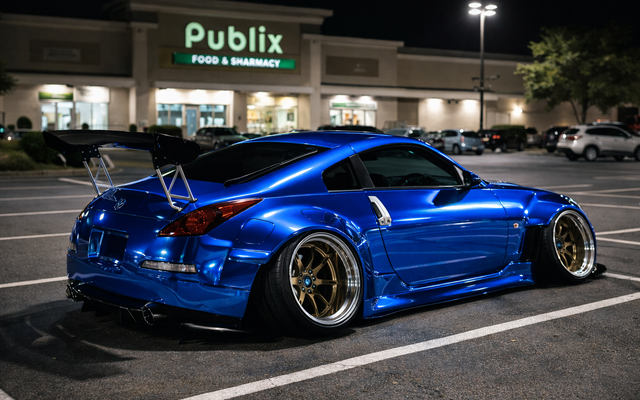
This American sports car offers a unique combination of benefits to the drifting sport, featuring a lightweight aluminum structure, a backwards-positioned drivetrain component that helps create an excellent balance, and the colossal thrust of a big LS V8 motor. This fusion renders it an utter monster on track, capable of starting and maintaining long drifts with apparently minimal deployment of throttle. For those desiring outstanding performance per dollar, the 350Z model Nissan rises above as a top-tier candidate. It is delivered from the factory with a robust body structure, a competent original limited-slip differential, and the smooth VQ series engine that offers plenty of performance for learning and progressing in the activity. Its newer version, the Nissan Z34, presents more advancements in structural rigidity, steering geometry, and overall engine output, cementing its status as a favorite choice among competitive competitors. Additional legendary platforms that warrant consideration include the nimble rotary-powered Mazda FC RX-7, the ubiquitous Nissan S13, the V8-powered Ford SN95, the electronic-equipped E90 3 Series, and the small yet surprisingly fun and forgiving Mazda Miata. Every single one of these platforms provides a different set of attributes, challenges, and potentials, but they all possess the fundamental ingredients required to become a capable drift machine.
However, selecting the optimal car is merely the starting point. To unlock the full capability of any of these cars, significant upgrades to the steering and chassis control systems are absolutely mandatory. This is where the world of precision tuning hardware enters vital focus. The most most game-changing modification for a serious drift car is the installation of a drift-spec angle modification kit. These engineered systems, for example those engineered by performance brands like specialist manufacturers, are created to significantly expand the chassis's possible lock-to-lock rotation. A OEM road car is extremely restricted in how far its tires can pivot, a engineering trade-off for on-road use. In oversteer driving, however, maximum opposite lock is frequently required to manage and maintain a drift. An angle kit exchanges the factory steering knuckles, tie rods, and often control arms with pieces that permit the steered wheels to reach steering lock in excess of 70 or even 80 °, versus a typical stock angle of around 40 to 50 °.
This vastly increased capability provides the operator with dramatically enhanced authority during a drift, making it considerably easier to initiate a slide, hold it through a extended corner, and change smoothly from one angle to the other. The improvement in drivability is nothing short of transformative. Coupled with a appropriately selected steering kit is the just as critical upgrade to the chassis's spring and damper setup. Off-the-shelf or even expensive street adjustable suspension are just not designed for the particular and harsh demands of drifting. A drift-spec pair of suspension units is of utmost importance. These specific dampers feature unique damping rates and spring rates that are designed for the rapid mass transition that is characteristic of sliding. When a pilot begins a drift, the chassis's inertia is shifted rapidly to the outer of the corner. Correct drift-spec coilovers manage this shift in a predictable way, allowing the car to find its balance quickly and providing the pilot precise feel through the wheel and driver's seat. They additionally provide accurate tuning of stance, shock absorber rate, and corner weighting, which are all integral aspects of fine-tuning the chassis's dynamics to a given venue or piloting technique. In combination, a top-tier angle modification system and a correctly selected pair of drift-spec adjustable dampers constitute the undeniable hardware cornerstone upon which all later refinement is built.
Once the essential hardware is in place, the following vital phase in the development is the detailed setting of the chassis's alignment. This is the domain of vehicle alignment optimization, a process that can seem overwhelmingly complex to the uninitiated but is, in fact, the key to turning a assembly of capable components into a harmonious and predictable vehicle. The most discussed element of suspension geometry for oversteer is definitely camber angle. Camber is the inclination of the rim compared to the perfectly straight axis when viewed from the front of the vehicle. If the upper part of the wheel is tilted inward, this is referred to as negative camber. For drifting, inward-leaning wheels on the front tires is universally employed and is considered critical. The purpose is fundamentally tied to physics.
When a vehicle is going around a bend at high angles, the frame tilts toward the external of the corner. This chassis roll causes the outer front wheel to lose its ideal grip area with the tarmac. By adding negative camber, the tire is pre-tilted to account for this lean. As the car rolls into the turn, the outside front tire gains a better contact patch against the track, maximizing its traction at the precise moment when it is absolutely essential for steering authority. Typically, front axle adjustments for a dedicated drift car vary from approximately -3 degrees to as high as -5 degrees or even greater, depending on the parameters of the chassis geometry, tire choice, and pilot style. The rear axle tires suspension tuning tool also use inward lean, but the angles are generally more conservative and subtler than the front. Too much inward lean at the back can result in the chassis overly tail-happy and challenging to manage on throttle use, as it diminishes the effective contact patch of the driven wheels during linear power delivery. Thus, rear camber settings are frequently in the ballpark of -1 degree to -3 degrees, finding a careful balance between giving enough cornering grip to help in starting and maintaining the angle while still keeping usable grip for power-down the corner. camber angle is only one part of the more complex suspension geometry puzzle, which additionally includes toe setting, caster, and suspension-induced steering modification.
Toe describes the direction of the tires when looked at from a bird's-eye view. Positive toe means the leading edges of the tires are closer together than the rear edges, while toe-out means the reverse. For drifting, a modest amount of front negative toe is commonly run to improve the initial steering reaction, making the chassis feel more agile and ready to begin a slide. Rear toe is typically set to zero or a very minute amount of positive vehicle dynamics tool toe to promote predictability under acceleration. self-centering is the forward or aft tilt of the steering axis when observed from the lateral of the car. Increased caster improves self-centering and high-velocity stability, and it additionally boosts inward lean increase during steering, which is extremely useful. Adjusting these settings is a complex dance where a change to one setting can and often will affect the others. The traditional approach for dialing in a chassis's suspension geometry for sliding has long been a tedious affair of guesswork and adjustment. A pilot or engineering group would apply a change based on a hunch, drive the car on track, use the operator's subjective perception and feedback, and then apply a further adjustment. This loop would iterate over and over until the chassis felt "right" or the scheduled practice period ran out. This system is not only incredibly slow in terms of hours and costs, but it is also fundamentally imprecise.
Pilot sensation is a infamously inconsistent measurement tool, affected by numerous variables such as tiredness, changing track conditions, weather, and just the mindset of the driver on that particular day. What feels "oversteery" on one pass might feel "pushing" on the next lap, resulting in conflicting data and ineffective adjustments. This traditional challenge in chassis setup is specifically where contemporary telemetry systems has intervened to transform the methodology.
The rise and integration of advanced suspension tuning applications has introduced a new age for engineering and perfecting professional drift cars. This new generation of platforms, represented by groundbreaking products like data acquisition tools, work by directly measuring the real-time dynamic performance of the car as it is being driven on the course. As opposed to using driver feedback, these tools acquire measurable metrics on essential parameters such as suspension travel, individual tire rotation, lateral and longitudinal g-forces, steering angle, and throttle and brake input. This raw information flow is then analyzed by powerful algorithms that can visualize and interpret the metrics in a clear format. For the first time, drivers and builders can observe specifically what the vehicle is performing at every moment of a lap. This capability transforms the whole suspension tuning process. Think about the aforementioned task of dialing in the front axle negative camber for a specific car. As an alternative to introducing a modification from -3 degrees to -3.5 degrees and then driving several laps to try and "perceive" a change, a vehicle dynamics tool can give instant and irrefutable information. The application can show visually how the tire's contact patch is acting during the critical phases of a angle: the initial flick, holding the angle, and switch. It can demonstrate if the current value is enabling the loaded tire to keep optimal grip or if the rubber is working inefficiently on its external shoulder.
The system can then make fact-based suggestions for modification. Perhaps the data reveals that the outside front tire is even overworking its edge at -3.5 degrees of camber, indicating that even more negative camber, say -4 degrees, might be advantageous. On the other hand, the information might show that the tread is not coming up to heat or that the inside shoulder is degrading excessively, which could indicate that there is excessive inward lean and a small lessening back to -3.2 degrees would be more optimal. This degree of precision and actionable intelligence was simply unimaginable in the time of pure seat-of-the-pants setup.
The benefit of employing a dedicated suspension tuning tool reaches far beyond just dialing in alignment. It functions as an essential coilover setup tips that is specific to your specific vehicle. When adjusting the rebound and compression settings on your suspension, instead of using imprecise advice or replicating another team's numbers, you can use the telemetry to analyze how the chassis is performing in response to your changes. The software can display the suspension travel data over a lap, showing if the shocks are controlling the body movement effectively or if they are permitting the vehicle to become unsettled excessively after a transition. It can assist in identifying problems like excessive compression or excessive extension, permitting you to introduce informed adjustments to preload settings, rebound/compression values, or ground clearance. This process translates similarly to the detailed art of corner balancing. In addition to camber angle, the tool can offer data into how modifications to toe and caster are affecting the vehicle's handling during specific parts of a lap. For instance, it can allow you to ascertain the ideal amount of front negative toe for your particular angle kit configuration and driving approach by measuring the response time of turn-in response and the consistency of the vehicle at maximum steering angle. This turns the system an incredibly powerful performance optimization handbook that is dynamically updated by the live behavior of your own car on the circuit. It shifts the entire project from a dark art into a scientific development process.
Moreover, the utility of a tool like modern telemetry is not at all confined to expert tuners with vast budgets. For the club-level driver, it functions as an incredible equalizer. It practically offers the tuner with the knowledge of a professional suspension specialist without needing the corresponding expense. It accelerates the development time by delivering unambiguous answers to challenges that would normally take years of trial and error to answer. A driver can see how their particular vehicle responds to specific settings, gaining a more intuitive comprehension of car control in the endeavor. It also democratizes high-level performance tuning concepts, permitting every enthusiast with the drive to perfect their machine to do so in a structured and successful way. This is especially valuable in car suspension tuning a discipline like drifting, where setup knowledge has traditionally been a tightly held asset among top drivers. Today, that capability can be in the garage of every dedicated driver.
In conclusion, the journey to building and tuning the ultimate high-performance drift car is a comprehensive project that seamlessly combines time-honored hardware wisdom with 21st-century data tools. It begins with the informed pick of a legendary chassis, then built upon the integration of essential drift-spec parts like high-performance angle modification systems and properly specified performance coilovers. The journey then progresses into the detailed phase of car suspension tuning, where settings like negative camber, toe setting, and caster angle are meticulously adjusted to match the vehicle's upgraded hardware and the operator's specific needs. Ultimately, and what truly separates the today's methodology from the old ways, is the integration of a powerful drift telemetry software. This platform eradicates the approximation and waste of solely subjective adjustment by delivering objective, actual telemetry on how the car is actually behaving. It serves as an incredible diagnostic aid, a comprehensive alignment optimization handbook, and a comprehensive chassis development system. In unison, this holistic philosophy ensures that all aspect of the drift car—from the choice of the car to the final adjustment on the coilover—is refined for maximum competitiveness on the competition venue. It represents the complete evolution of the discipline of sliding, connecting physical driving skill with surgical chassis dynamics to forge the most competitive vehicles attainable.